

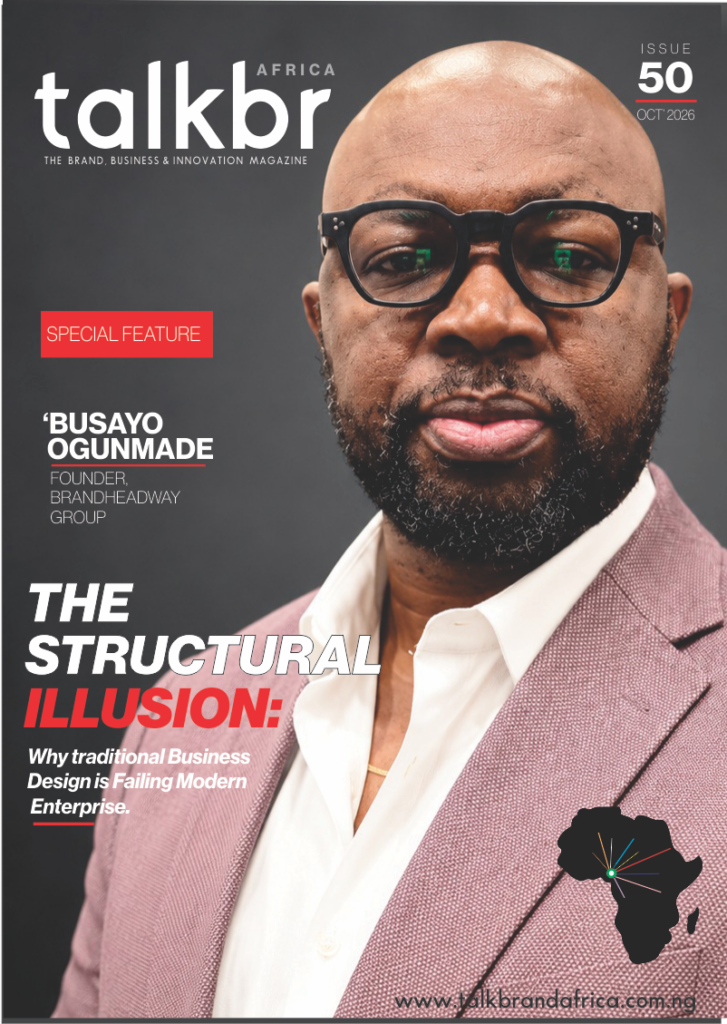
DOWNLOAD THE FULL MAGAZINE https://drive.google.com/file/d/1olC78IpCEAy6Jfr0SuIX2P11S-usJqrD/view?usp=sharing
.
.
The Structural Illusion: Why Traditional Business Design is Failing Modern Enterprise
An Exclusive Interview with Busayo Ogunmade, Founder of Brandheadway Group
Conducted by:TBA (Talk Brand Africa Magazine Crew)
Published in:Talk Brand Africa Magazine (talkbrandafrica.com.ng)
The Fallacy of the Corner Office
For decades, the African corporate landscape has chased a ghost: the illusion that a business is built when you lease a sprawling suite in Victoria Island or Ikeja, fill it with imported mahogany desks, and print an immaculate, multi-tiered organizational chart.
We have equated real estate with readiness and bureaucracy with maturity. But beneath the polished veneer of many modern enterprises lies a fragile reality—businesses that grind to a halt the moment the founder steps away.
To unpack why traditional business design is crumbling under the weight of market volatility, the Talk Brand Africa (TBA) magazine crew sat down with Busayo Ogunmade, the visionary founder of Brandheadway Group. In this hard-hitting, no-holds-barred conversation, Ogunmade dissects the myths of corporate structuring and reveals why true business architecture has nothing to do with square footage—and everything to do with a system that runs on autopilot.
The Interview
TBA: Busayo, thank you for sitting down with us. Let’s dive straight into the deep end. Across the African corporate and SME ecosystem, founders are obsessed with “scaling up” their physical and structural appearance. You’ve boldly termed this “The Structural Illusion.” Break that down for our readers. What is traditional business design getting fundamentally wrong?
Busayo Ogunmade: Thank you for having me. Let’s stop lying to ourselves. For the longest time, we’ve inherited a colonial mindset of what a “serious” business looks like. Founders think business structure is about renting a massive office space, hiring twenty people to fill slots on an organigram, and buying expensive tables and chairs just to look busy.
That is not a business structure; that is an expensive theatrical production.
The structural illusion is the belief that real estate, titles, and red tape equal operational maturity. When you walk into many offices, there is plenty of space, plenty of chairs, but absolute zero clarity on how a task flows from conception to execution without the founder screaming across the hallway. If your business requires your physical presence, your emotional energy, and your direct micro-management every single second to function, you do not own a business. You own a very stressful, high-rent job.
“If your business requires your physical presence, your emotional energy, and your direct micro-management every single second to function, you do not own a business. You own a very stressful, high-rent job.”
TBA: That is a provocative distinction. If structure isn’t about the organigram or the physical office space, what actually constitutes a true business structure?
Busayo Ogunmade: Structure is an operating system, not a floor plan.
A true business structure boils down to three things: A checklist of what works, a documented standard of how it is done, and the exact individuals accountable for executing those tasks in a systematic order.
It is about operational clarity. It’s a living playbook. If an employee walks in tomorrow, they shouldn’t have to guess how a client brief is handled, how a PR crisis is mitigated, or how an invoice is processed. The system dictates the rhythm. When you have a genuine structure, the business runs on pilot. It works seamlessly whether you are sitting at your desk, traveling, or taking a month off to clear your head.
TBA: Let’s talk about execution, because at Brandheadway, your mantra is that “Execution is the Strategy.” In an environment like Nigeria, where market conditions fluctuate wildly—from currency shifts to infrastructure gaps—how can a business build a “pilot-mode” system that doesn’t break under pressure?
Busayo Ogunmade: Volatility is actually the best argument for systems, not against them. Many African founders say, “Ah, the Nigerian market is too dynamic for rigid structures; you have to improvise.” That is a lazy excuse for chaos.
Improvisation is a survival tactic for day one; it is a death sentence for year five. When the market is volatile, your operational backbone must be rock-solid.
A “pilot-mode” system doesn’t mean automated robots with no human touch. It means delegation married to accountability. It means asking: If the internet goes down, what is step B? If a key vendor fails, who signs off on the backup protocol? When roles, checklists, and workflows are documented and internalized by your team, the business absorbs shocks. The founder stops being the shock absorber and starts being the strategist.
TBA: Many growing businesses start with talented people who rely heavily on the founder’s genius. How do you transition a team from “founder-dependent” to “system-reliant” without killing their creativity or slowing down momentum?
Busayo Ogunmade: You do it by documenting the unspoken. Most founders keep their processes in their heads. They wake up every day and dispense instructions like an oracle.
To shift to a system-reliant model, you must force yourself to extract what is in your head and put it on paper. Codify your brilliance. If you design a brilliant brand strategy deck or manage a client brief in a specific way once, record the steps. Turn your genius into a template.
Secondly, you must reward ownership, not obedience. Traditional structures reward people for waiting for the boss’s approval. True systems empower competent people to execute within defined guardrails. When your team knows the boundaries and has the checklist, they move with speed. Creativity doesn’t thrive in chaos; true creative execution thrives when administrative friction is eliminated.
TBA: To wrap this up for our readers—founders, executives, and entrepreneurs building across Africa—what is your final verdict on escaping the structural illusion?
Busayo Ogunmade: Stop investing in impressions and start engineering execution. Stop worrying about how many offices you have or how impressive your job titles look on LinkedIn. Look at your operations. If you vanished for thirty days and the company’s revenue, quality, and client satisfaction dropped to zero, your business isn’t structured—it’s bottlenecked. Build systems that outlive your presence. That is the only way to build an enterprise that matches global standards while being truly built for African business.
SIDEBAR: THE FOUNDER’S STRUCTURAL AUDIT
Stop measuring your business by real estate and titles. Run your enterprise through this 4-point operational test.
- The Absence Test
- The Question: Can your core service or product be delivered seamlessly if you take a two-week offline break with zero access to your phone or email? (Yes/No)
- Reality Check: If customer satisfaction or revenue drops the moment you step away, your business isn’t structured—it’s bottlenecked.
- The Playbook Test
- The Question: Do your team members execute recurring tasks using documented checklists and standard operating procedures, or do they walk into your office every morning asking, “How should I handle this?”
- Reality Check: If every process lives only inside your head, you haven’t built a company; you’ve created a high-stress job for yourself.
- The Asset vs. Optics Test
- The Question: Are you allocating capital toward operational software, automated workflows, and documented systems, or are you over-investing in office aesthetics and empty organigram boxes just to look ‘serious’?
- Reality Check: Real estate and mahogany desks do not close sales or deliver briefs. Systems do.
- The Accountability Test
- The Question: Is every single role in your organization tied to a measurable, repeatable output, or are people just ‘coming to work’ to fulfill vague daily activities?
- Reality Check: True structure removes ambiguity. Everyone should know precisely what success looks like on their desk before you even arrive at yours.
[C] talkbrand Africa