

TALKBRANDAFRICA MAGAZINE
EXCLUSIVE LEADERSHIP INTERVIEW
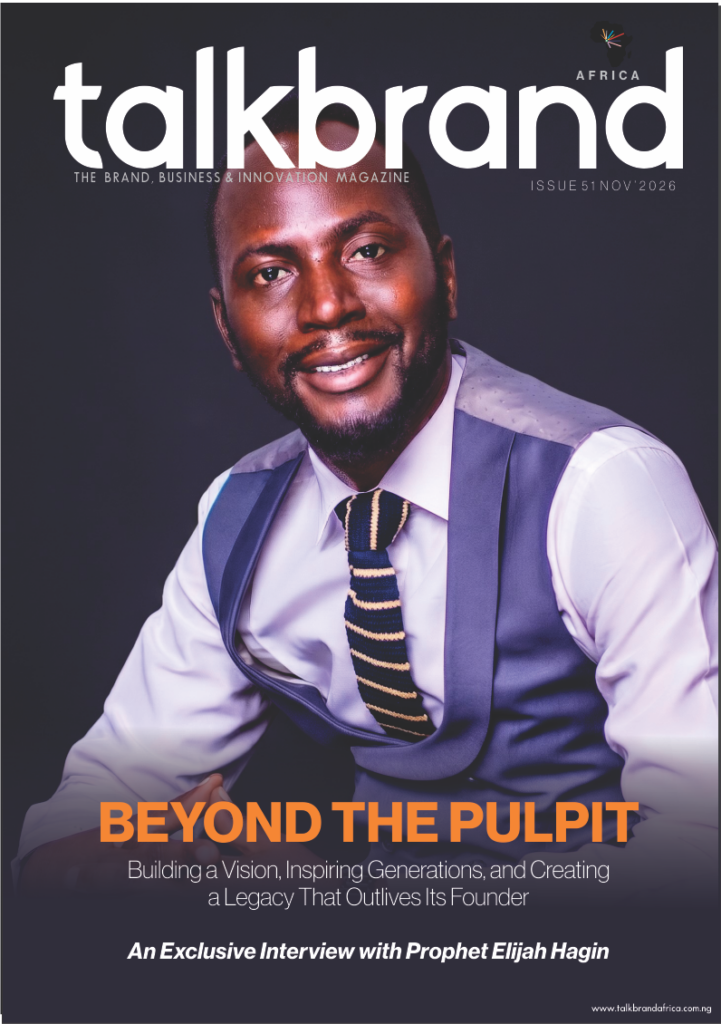
BEYOND THE PULPIT: BUILDING A VISION THAT OUTLIVES GENERATIONS
An exclusive conversation with Prophet Elijah Hagin on visionary leadership, ministry, economic resilience, influence and preparing the next generation.
1. INTRODUCTION
[TBA – TALKBRANDAFRICA MAGAZINE CREW]
Welcome to another exclusive edition of TalkBrandAfrica Magazine, where we engage distinguished voices, thought leaders and influential personalities shaping conversations around leadership, business, faith, governance and societal transformation.
Today, we are delighted to have with us a man whose leadership philosophy extends beyond the pulpit and whose vision is focused not merely on present achievements but on building a legacy that will endure for generations.
Joining us is Prophet Elijah Hagin, a minister whose experience in building and sustaining ministry in Borno State, Northern Nigeria, has shaped his perspectives on visionary leadership, institutional development, resilience and generational impact.
In this conversation, we explore what it takes to build something that outlives its founder, how leaders can navigate challenging economic realities without losing sight of their vision, the importance of communicating with clarity in an increasingly noisy world, and the responsibility of preparing the next generation for leadership.
We will also examine his thoughts on leadership in ministry and politics, the importance of accountability, and why true leadership should ultimately be measured by the lives transformed rather than the positions occupied.
Prophet Elijah Hagin, it is a pleasure to have you on TalkBrandAfrica Magazine.
Welcome to the conversation!
2. INTERVIEW SESSION
QUESTION 1: ON STAYING POWER
VISION & LEGACY
TBA: Prophet, building something that stands the test of time requires more than passion; it demands vision, discipline and the ability to think beyond immediate results.
You have spoken about building a lasting ministry in Borno State, Northern Nigeria, where the environment itself presents unique challenges.
What has this journey taught you about building institutions that can survive beyond their founders? And how do you balance the demands of present-day ministry with the bigger picture of establishing a legacy for future generations?
PROPHET ELIJAH HAGIN:
BUILDING A VISION THAT OUTLIVES GENERATIONS
Building a lasting ministry in Borno State, Northern Nigeria, has taught me that vision must be stronger than the environment in which it is born.
I have learned the importance of conviction, consistency, leadership development, and thinking beyond one’s lifetime.
One of the leadership figures whose teachings and approach to vision, ministry, and institution building I follow with great interest is Ambassador Uebert Angel. His emphasis on thinking big, developing capacity, building institutions, and approaching ministry with a global mindset has been an important source of leadership inspiration to me.
I believe that where you are should never determine how far you can see.
My desire is not merely to build a growing church, but to raise leaders, transform lives, establish lasting institutions, and create a legacy that will serve generations.
I am not building for applause today; I am building for impact that will outlive me.
QUESTION 2: ON NAVIGATING TOUGH ECONOMIC TIMES
ECONOMIC RESILIENCE
TBA: Across Africa, individuals, businesses, religious institutions and governments are navigating increasingly difficult economic realities. In such circumstances, leadership is often tested by the quality of decisions made under pressure.
From your perspective, how should leaders navigate economic uncertainty without allowing fear, pressure or prevailing circumstances to compromise their long-term vision?
PROPHET ELIJAH HAGIN:
I believe leaders must learn to separate fear from facts. Economic challenges demand wisdom, not panic. A good leader must remain calm, protect resources, prioritise essentials, avoid unnecessary risks, and make decisions based on facts rather than emotions.
My philosophy is that difficult seasons are not the time to abandon vision, but the time to strengthen strategy, discipline, and financial intelligence.
As leaders, we must keep our faith strong, our thinking clear, and our decisions wise.
QUESTION 3: ON CUTTING THROUGH THE NOISE
COMMUNICATION & INFLUENCE
TBA: We live in an era where everyone is competing for attention. Social media, digital platforms and the constant flow of information have made it increasingly difficult for leaders to communicate messages that genuinely resonate with people.
In your experience, how can leaders, particularly those in ministry and public life, distinguish themselves in such a crowded environment without compromising their values or becoming overly concerned with popularity?
PROPHET ELIJAH HAGIN:
I believe clarity is more powerful than noise. You don’t need to shout louder than everyone else; you need to communicate a message that carries value, conviction, and authenticity.
My approach is to remain consistent with my message, understand the people I am communicating with, embrace technology, and focus on impact rather than popularity.
When your message is rooted in purpose and supported by substance, you don’t have to chase attention; you build trust, and trust gives your voice influence.
QUESTION 4: ON RAISING THE NEXT GENERATION
SUCCESSION & MENTORSHIP
TBA: One of the greatest challenges facing institutions across Africa is succession. We have seen organisations and institutions struggle to maintain their standards, values and vision when leadership transitions occur.
What do you consider the most important lessons established leaders must pass on to the younger generation? And how can today’s leaders ensure that those coming after them are not only prepared to inherit positions but also equipped to sustain and improve what has been built?
PROPHET ELIJAH HAGIN:
I believe the most important thing older leaders must teach the younger generation is the value of responsibility, character, and stewardship.
Don’t just teach them how to occupy positions; teach them how to carry responsibility, preserve values, develop people, and make wise decisions.
Leadership is not about inheriting a title; it is about understanding the assignment and having the capacity to sustain it.
Our responsibility is not merely to leave the next generation something to inherit, but to prepare them with the wisdom and character to preserve, improve, and expand it.
QUESTION 5: ON LEADERSHIP IN MINISTRY AND POLITICS
GOVERNANCE & RESPONSIBILITY
TBA: Prophet, leadership in both ministry and politics comes with enormous responsibility because decisions made by those in authority often have far-reaching consequences for individuals, communities and entire generations.
Africa has no shortage of people aspiring to leadership positions, but the real question is whether those individuals possess the character, discipline and vision required to lead effectively.
What would be your greatest advice to leaders in ministry and politics who desire to make meaningful contributions to society and leave behind a legacy worth celebrating?
PROPHET ELIJAH HAGIN:
Yes. My greatest advice to leaders in ministry and politics is this: Never become so obsessed with the position you occupy that you forget the people you are called to serve.
I would emphasise seven principles:
1. Character before influence: Your integrity will sustain what your charisma attracts.
2. Vision beyond personal ambition: Build institutions, not monuments to yourself.
3. People before personal interests: Leadership is a responsibility to improve lives, not an opportunity for self-enrichment.
4. Continuous learning: Never allow your position to make you resistant to new knowledge, ideas, and changing realities.
5. Accountability: Surround yourself with people who can question your decisions. Never create an environment where everyone must agree with you.
6. Succession and mentorship: Raise people who can carry the vision further than you have taken it.
7. Courage with wisdom: Not every battle deserves your attention, and not every opportunity deserves your investment.
My final advice:
Whether in the church or in government, leadership should be measured not by the power you exercise, the titles you carry, or the wealth you accumulate, but by the lives you transform, the institutions you establish, and the future you leave behind.
A great leader does not just make history; a great leader prepares others to make history.
3. CLOSING REMARKS – TBA
TBA – TALKBRANDAFRICA MAGAZINE CREW:
Prophet Elijah Hagin, thank you for sharing your insights and perspectives with us.
This has been a truly enlightening conversation, particularly your emphasis on the importance of building beyond personal ambition, leading with character, exercising wisdom in difficult seasons, and preparing the next generation to carry the responsibility of leadership.
One message that stands out throughout this conversation is that leadership should never be reduced to titles, positions or personal accomplishments. Its true value lies in the institutions we build, the people we empower and the positive impact we leave behind.
Your perspective on building a vision that outlives generations is a timely reminder that meaningful leadership requires us to look beyond ourselves and consider the future we are creating for those who will come after us.
On behalf of the entire TalkBrandAfrica Magazine team, we sincerely appreciate your time, openness and willingness to share these valuable thoughts with our audience.
To our readers and viewers, thank you for joining us for this exclusive conversation.
Keep following TalkBrandAfrica Magazine as we continue to spotlight influential voices, extraordinary stories and thought-provoking conversations shaping Africa’s leadership and development landscape.
Until our next edition, remember: Greatness is not just about what you achieve in your lifetime; it is also about what continues to thrive because you lived.
This is TalkBrandAfrica Magazine.
We tell the stories. We spotlight the visionaries. We amplify the voices shaping Africa.
Thank you, and goodbye!
(c) TALKBRAND AFRICA